
As you consider the artwork each week, reflect on the following questions:
What memories come up as you look at it? Does it remind you of anything you’ve seen before?
Is there anything in the image you wish were different? Can you sense why?
Does the image seem to ask something of you or invite you into anything?
Where does your attention naturally settle when you look at this artwork?
What feelings or desires does this image stir in you?
What story—or whose story—does this image seem to tell (or leave untold)?
Art in Advent
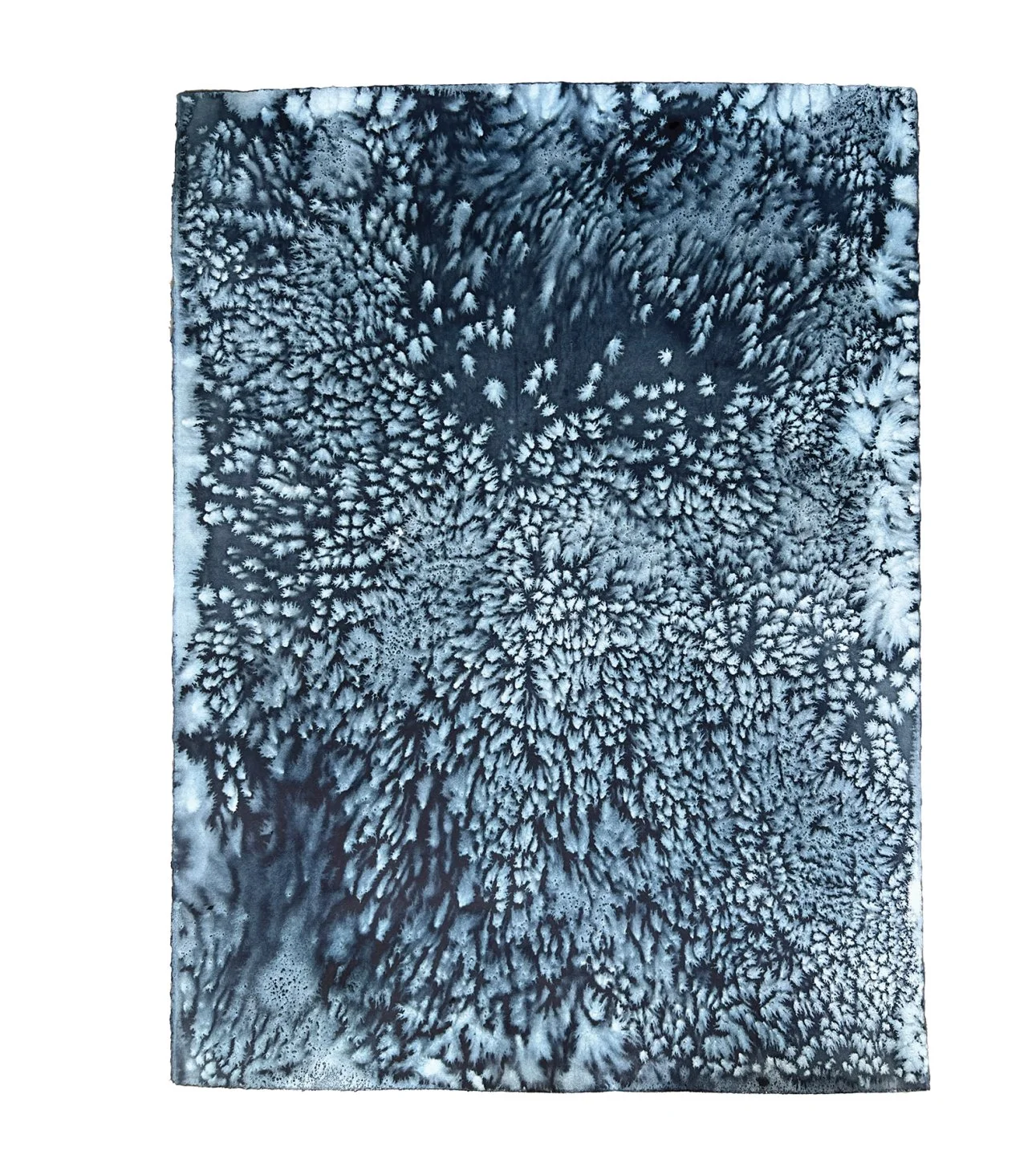
Affection by Julia Hendrickson
from the What Lies Beneath series
Watercolor and salt on paper, 22″ x 30″, 2023
For Julia Hendrickson, art is both meditation and prayer—a practice she calls opera divina, or “holy work.” Building on the Benedictine motto ora et labora (“pray and work”), she suggests that our work itself can become a form of prayer. Her process is simple and intentional: she wets thick white paper with broad brush strokes of water, then repeatedly dabs or splatters a single hue—Payne’s grey. While the surface is still wet, she sprinkles salt across the paint. The crystals repel pigment and absorb water, creating unexpected starbursts that reveal the marks beneath. As the paint dries, the forms shift and fractal patterns emerge. Though her technique repeats, the results are always unique and surprising.
Hendrickson’s work teaches us to anticipate transformation. John tells us the Incarnation is light shining in the darkness. In Hendrickson’s time-lapse videos, deep blue-gray pigment spreads across white paper until the salt crystals touch it—and suddenly the darkness breaks open into glimmering light. We wait, and we watch. The Incarnation is not God briey slipping into human skin. It is something more mysterious—like salt, pigment, and water remaining themselves yet becoming something utterly new together.
For further reflection on this artwork, read this Christianity Today article: “Art and the Incarnation” by Elissa Weichbrodt
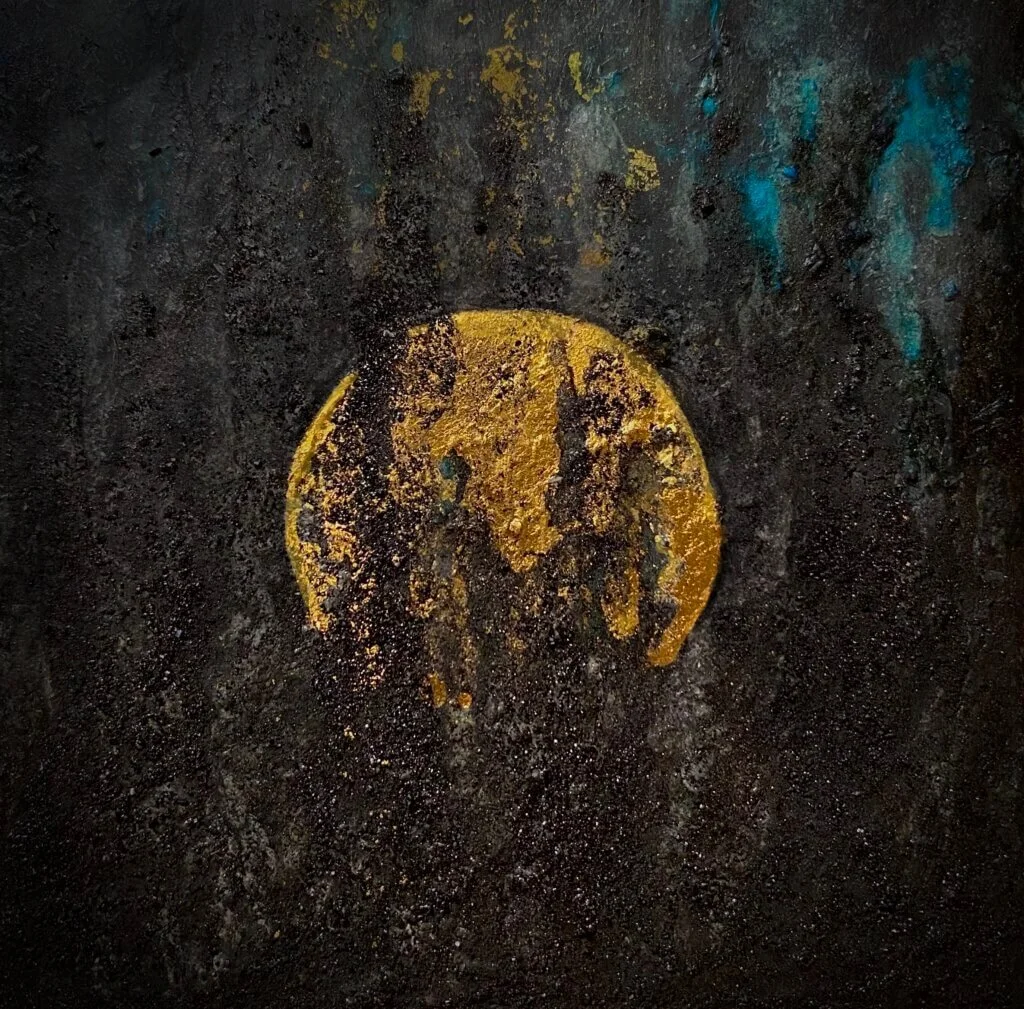
Incarnation by Tim Joyner
(American, 1987–), 2021.
Foraged pigment on board-mounted paper, 4 × 4 in.
Tim Joyner is an artist who works primarily with natural pigments and inks derived from locally foraged materials, such as stone, lichen, and seaweed. He is also the worship director at Trinity Church Congregational in Boston, Massachusetts, where he lives with his wife and four kids.
Incarnation is a painting he made during Advent 2021. He describes its makeup and meaning in a Rabbit Room blog post:
“The painting . . . is pretty dark for an Advent piece. It’s primarily Lamp Black (a pigment that I associate with longing and prayer because I make it from the discarded stubs of vigil candles), with some even darker Jet Black. There’s some white from Jingle Shells and a bit of Verdigris, but those are there mostly to make the black pigment look even blacker. Even the orb of gold leaf in the very center of the painting is obscured enough that it mostly just draws attention to the rising movement of dark pigment.
This painting is a reminder to myself that, yes, at the end of all this waiting there is an arrival. But it’s not me arriving at the other end of darkness or doubt, brokenness or betrayal. It is the Christ Child who arrives. He meets us here. And rather than chasing away all that it means to be human—including the pain and the longing unfulfilled—and banishing it forever, He wraps Himself in it. We find Christ not on the other side of our longing, but within it.”
For further reflection on this artwork, read Tim’s Reflections in a Rabbit Room blog post
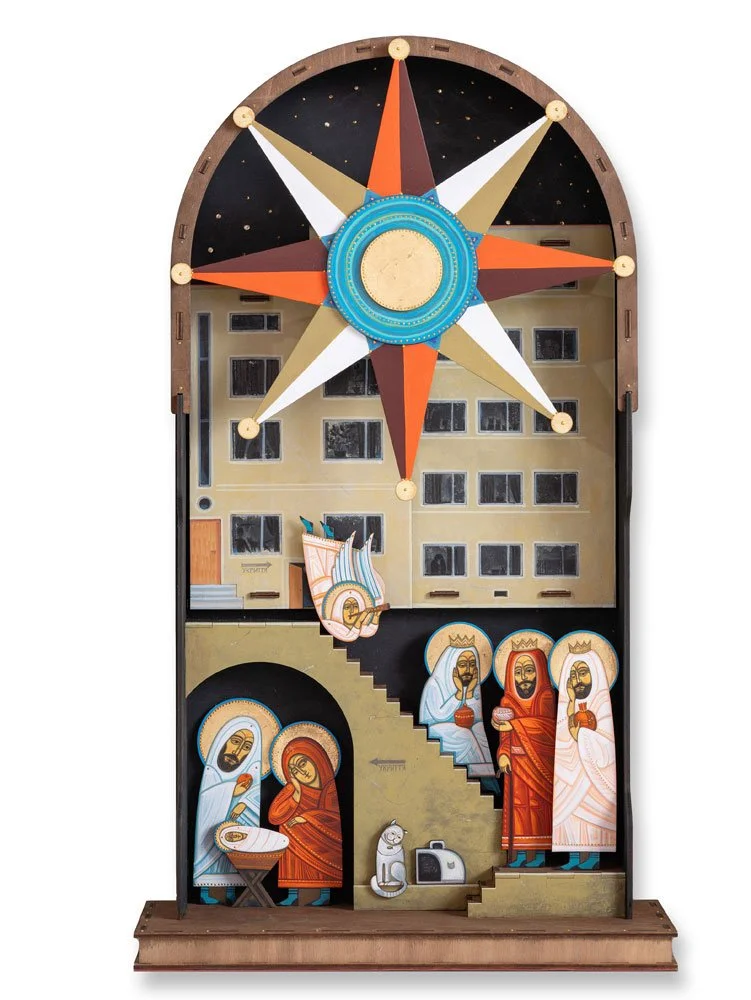
Christmas in the Air Raid Shelter
by Olya Kravchenko
Ukrainian, 1985–), 2024.
Plywood, tempera, and gilding.
For Christmas 2024, with Russia still launching missiles and drones against Ukraine, Ukrainian iconographer Olya Kravchenko created a three-dimensional painting of the Holy Family huddled in the basement of an apartment complex, taking shelter from air raids. Above them, a bright star guides the magi to the place where Jesus lies.
The contrast between the hiding family, the stark Soviet-era apartment block, and the celestial brilliance of the star creates a dynamic interplay between human fragility and divine promise.
Christmas in the Air Raid Shelter testifies to the fractures of our world, while the tiny, luminous Christ child becomes a symbol of unity and renewal. It challenges us to recognize Christ in every modern basement, trench, street, and shelter. It declares that the holy does not avoid suffering but is born within it. Viewers are invited to join the magi in bearing witness—to look for and honor the divine presence that persists even in chaos.
Ultimately, the piece proclaims the enduring truth of Christmas: light shines in the darkness, and the darkness has not overcome it.
Adapted from:
https://eurasia1.wordpress.com/2025/01/07/christmas-in-the-air-raid-shelter-by-olya-kravchenko/
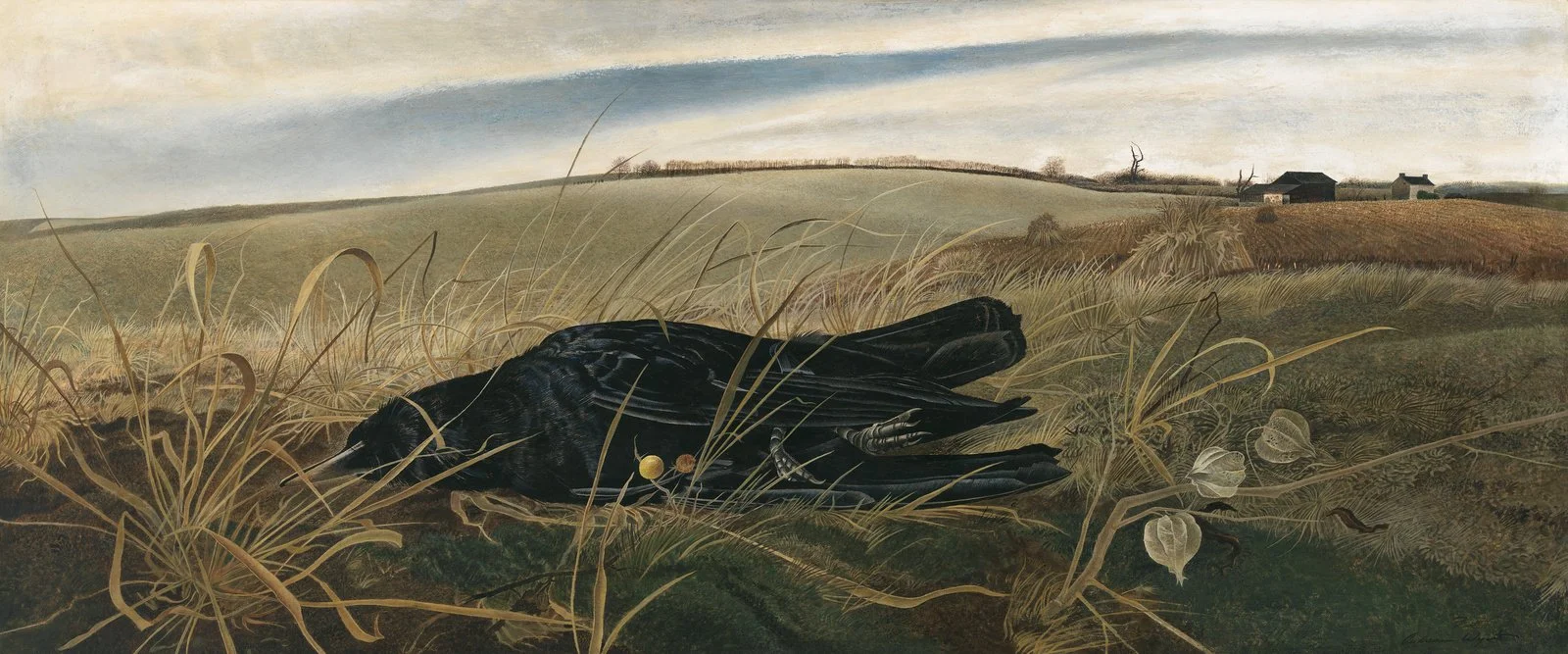
1942. Tempera on board.
Collection of the Whitney Museum of American Art.
Andrew Wyeth’s Winter Fields may not seem like an Advent artwork. It’s a small, quiet painting: a strip of Pennsylvania farmland in cold winter light, seen from a low, almost insect-like vantage. At the center lies a jet-black dead crow—its twisted body and flattened grass making the scene unmistakably about death.
Created during World War II, the image echoed the grim photographs of battlefields beginning to appear in American newspapers. For many, it was—and is—a stark meditation on mortality.
But look closer. Against the bird’s dark silhouette, the pale grasses and a winter-cherry plant stand out. Two warm, golden berries punctuate the crow’s breast, and nearby, three papery seed pods hang like tiny lanterns in the cold air. At first they seem to echo the theme of death—dry, rattling forms, drained of life. But they carry a different message. Hidden within those husks are seeds waiting for spring. After wintering in the soil, they will germinate, sending up new green shoots, fresh fruit, new life. The fragile lanterns do not mirror the crow’s death; they quietly oppose it with hope. They are resurrection in waiting.
Wyeth wasn’t a Christian, yet he sensed that the material world can be charged with spiritual meaning. Winter slows us down, inviting us to trust that life will return. In a single painting, he gives us loss and promise, grief and renewal—death and life existing together in a mysterious already-and-not-yet.
We cannot rush resurrection. But Advent reminds us that Love meets us in the waiting.
Adapted from https://substack.com/home/post/p-153211954
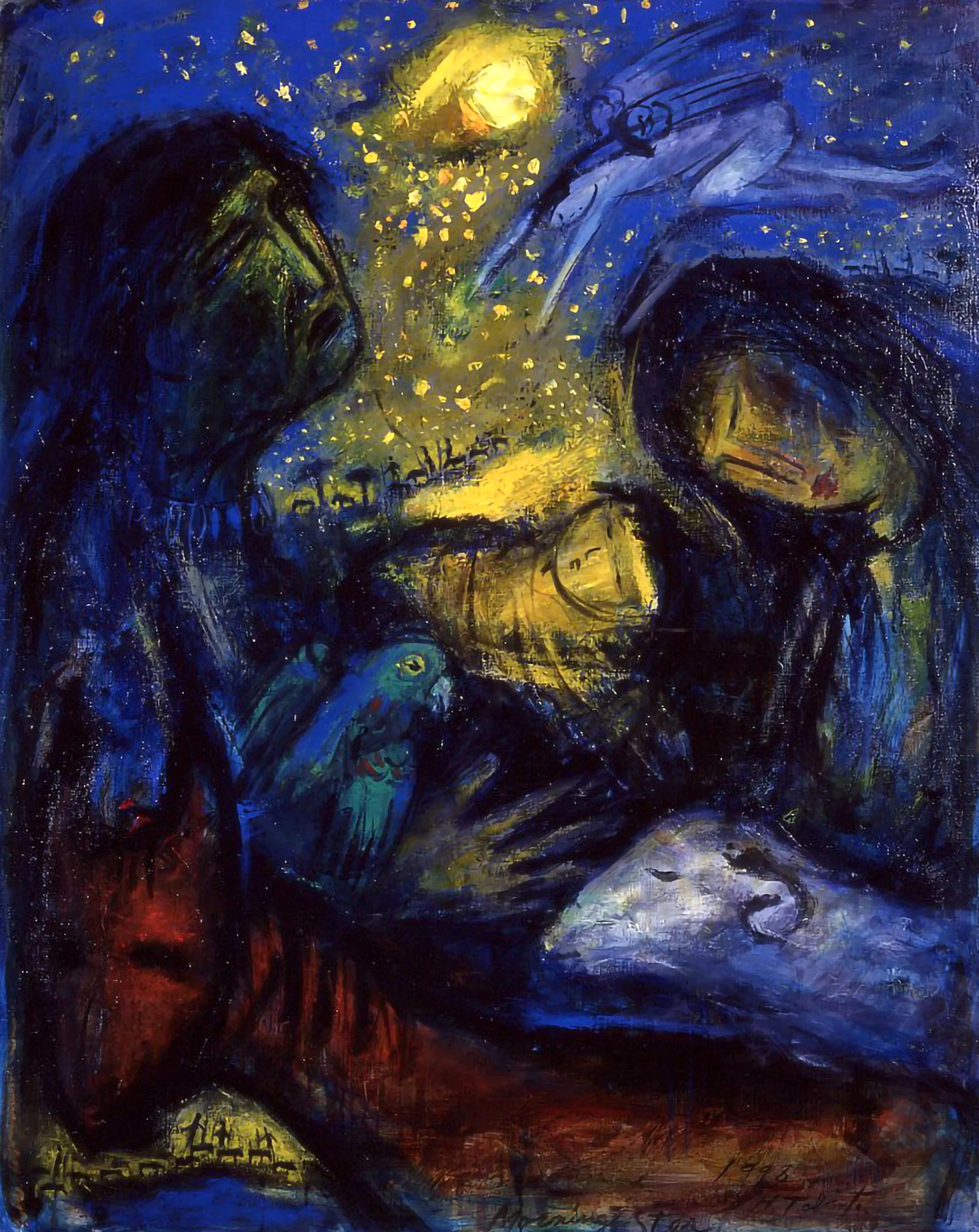
Japanese, 1998. Oil on canvas, 90.9 × 72.7 cm.
“In Tabata’s expressionistic Morning Star, starlight falls in a luminescent sheen over the face of the Christ child, whom Mary looks upon in tender adoration as Joseph wonders at the angelic activity above. The tight cropping around the Holy Family heightens the sense of intimacy. A sheep, donkey, and Amazon parrot (the latter a callback to the artist’s time in Brazil) crowd into the foreground, while on distant hills shepherds behold the glorious light display, hearing the announcement that will propel them to their newborn Messiah. The wise men, too, are on their way. Epiphany is at hand. Heaven’s raining down (Isa. 45:8).”
Quoted from the blog Art and Theology by Victoria Emily Jones
https://artandtheology.org/2023/01/06/epiphany-glory/
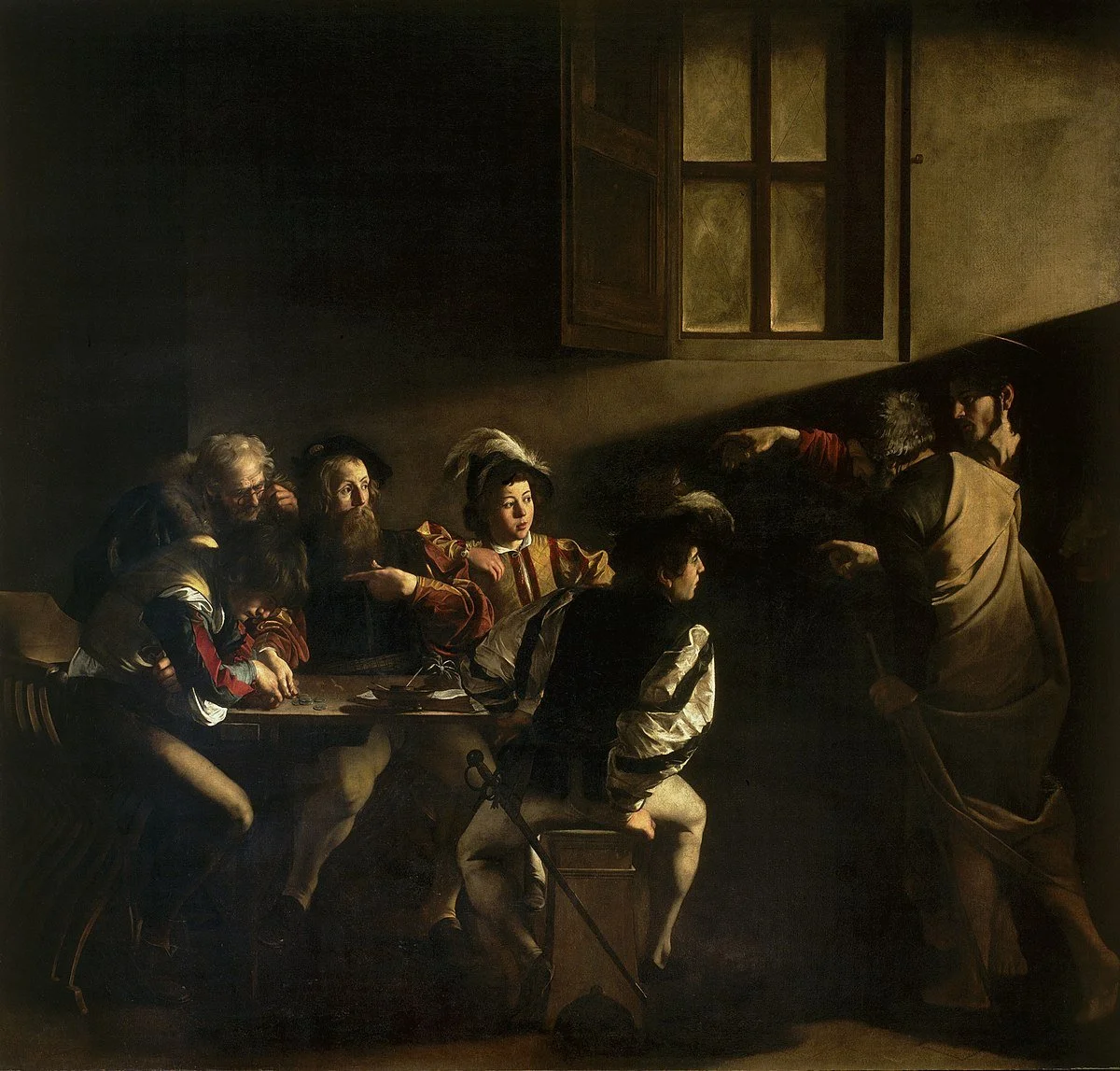
Oil on canvas, c. 1599–1600
(Contarelli Chapel, San Luigi dei Francesi, Rome).
This painting captures the decisive moment when Jesus calls the tax collector Matthew to follow Him. In that instant, Matthew is invited to leave behind his former life and to enter a new community shaped not by blood or status, but by discipleship.
This is the beginning of Matthew’s belonging to a new fellowship of believers, a new family formed by Christ’s call. Peter stands beside Jesus as the sign of the Church, the earthly household into which Matthew is being welcomed.
Caravaggio’s dramatic use of darkness and light reinforces this transformation: Matthew is illuminated by the light that enters with Christ, symbolizing the passage from the shadows of the old life into the grace and glory of the new.
Join Dr. Beth Harris and Dr. Steven Zucker as they walk through the church of San Luigi dei Francesi in Rome and look at the paintings by Caravaggio in the Contarelli Chapel. https://smarthistory.org/caravaggio-calling-of-st-matthew/
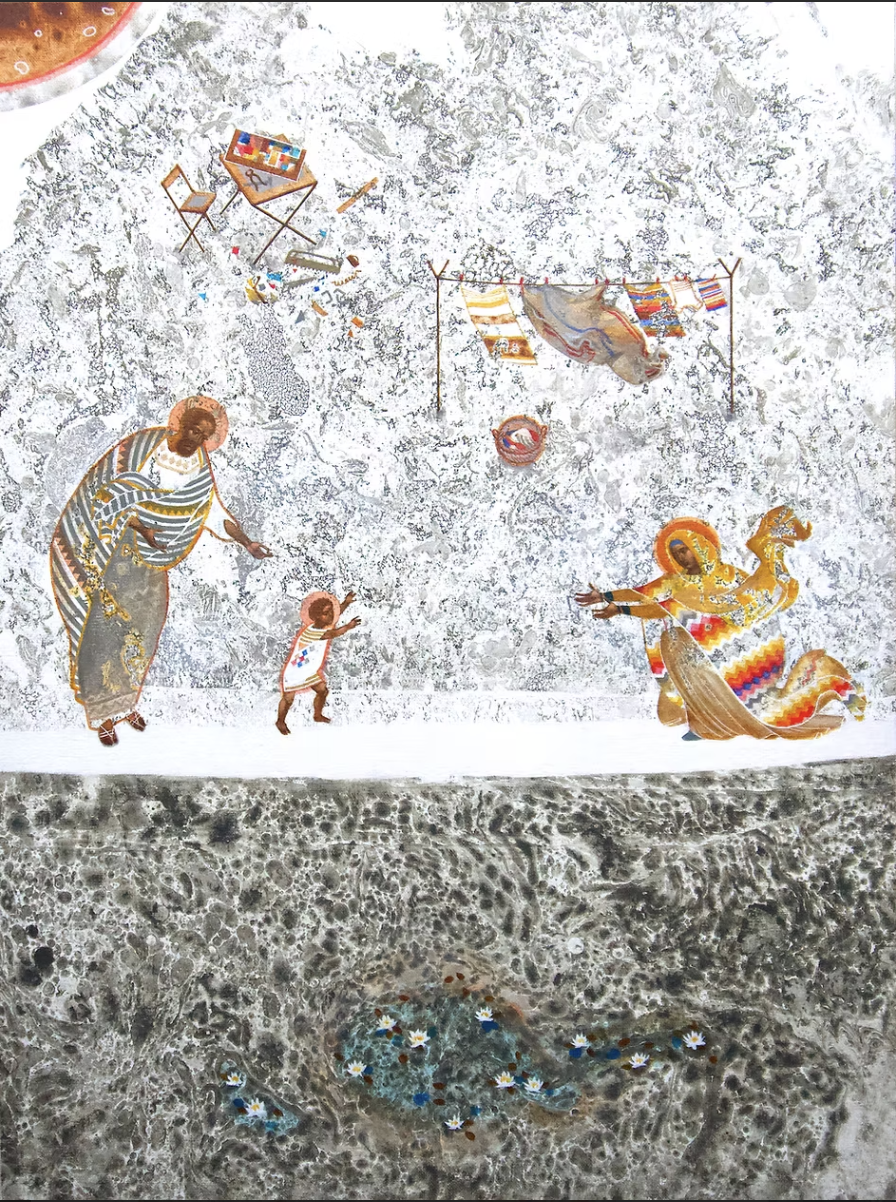
Hidden Life in Nazareth
by Ivanka Demchuk
(Ukrainian, 1990– ),
Mixed technique on canvas and wood.
“The plot [of Hidden Life in Nazareth] is rarely found in icons—though sometimes it can be seen in Western European paintings—but it is one of my favorites. Usually, icons present some important, significant events in the life of the saints. [This piece instead portrays Jesus experiencing] a simple and unremarkable family life, full of its routine, joys, and worries – a scene of household intimacy, such as you and I have. This brings distant history so close to modern man. Holiness does not require any special circumstances. There is only one prerequisite – it is love, and it grows in our families, among friends, every day, quietly and imperceptibly in order to make the world a better place in due time.”
– Artist Statement from Ivanka for Oak Parish’s reflection